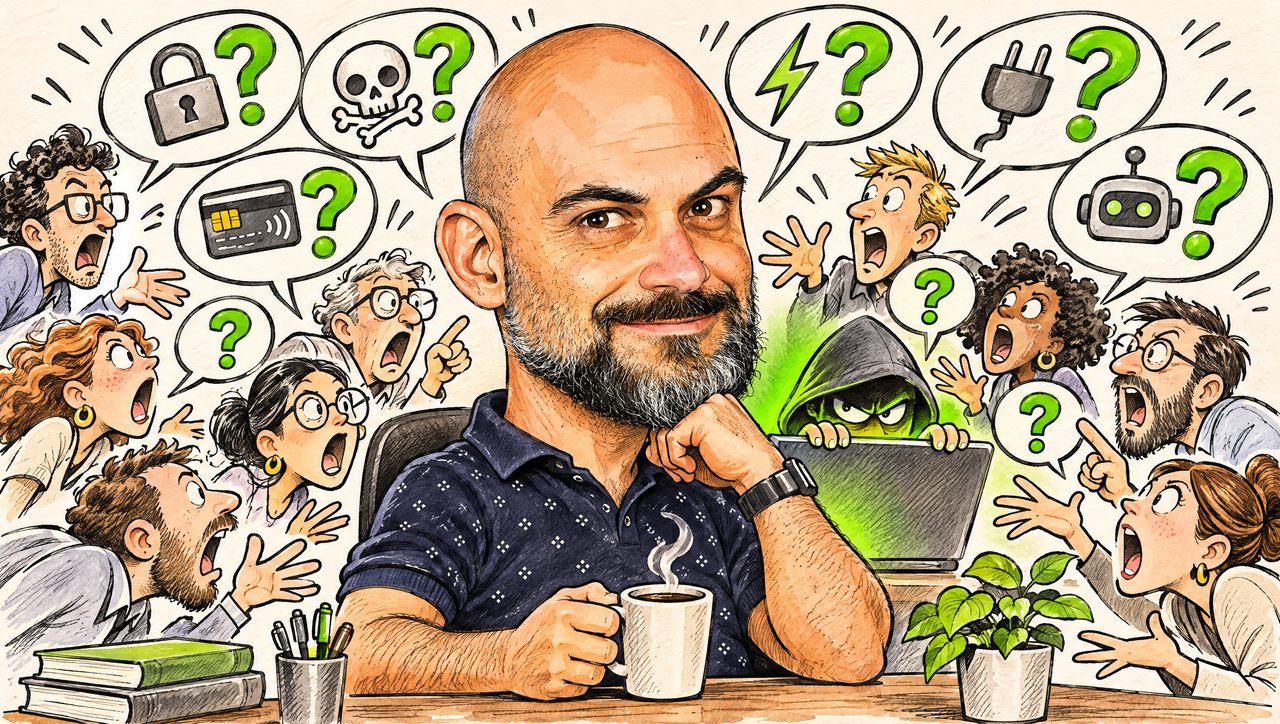
Every time something big “goes down”, my phone rings with the same questions: from friends, clients, journalists, even my aunt. I gathered them here and answer them one by one, in plain words.
1. “If someone only knows my mobile number or email, can they hack me?”
If they only know your phone number or email, as a rule they cannot get into your accounts or your camera. Those details give them a ticket to start a more targeted attack: a very convincing SMS “from your bank”, a call from “technical support” or “your accountant”, an email with a malicious link. In the vast majority of cases, a breach needs a move by the user, made out of carelessness or ignorance: a click, a password they shouldn’t have given, or one shared password they use on every system. By the way, we live in times when every site needs its own, different password.
There are also cases that need no action from us at all:
- Leaks from sites we use: a site where we have an account is breached and our password circulates. If we use the same password elsewhere, we’re in trouble, because anyone targeting us will check which passwords of their would-be victim have leaked and start trying whatever they find.
- Attacks like the one we saw last week, where legitimate, well-known sites served malicious code to their visitors because one of their suppliers had been hacked.
- So-called “zero-click” spyware, which infects a phone without the user clicking anything (as Pegasus did in the past). It is very expensive and targeted, and concerns specific people, not the average citizen.
- SIM swap: the fraudster convinces the mobile carrier to hand over our number (not particularly common in Greece).
A citizen’s defence is to take a few simple steps so as not to become an easy target; not becoming a target at all is hard.
- A different password for every service,
- Two-factor authentication everywhere (Gmail, Microsoft, Hotmail, Apple) on every service that offers it,
- Up-to-date software on both our computer and our phone,
- And the rule: “I don’t reply to a message that asks me to hurry.”
2. “Who are these hackers anyway, and how do they get in?”
The well-known hacker in a hoodie in a secret basement exists, but in my personal view he is the minority. Most of the cyberattacks we see fall within organised crime with a business model. There are ransomware “companies”, if we may use that word instead of criminal organisations, which have partners (affiliates), suppliers of specialised software, and even technical support for their victims. Their goal is one: money.
There are groups linked to states and state interests, meaning they are either funded by a state or the state simply knows who they are and turns a blind eye to their activities. For example, we know of states that have told such groups: you may freely hit the whole world, but if you attack a business in our own country, we will destroy you. These groups pursue espionage, influence, or preparation for a moment of crisis when they will need it. One example is that they may already have access to state structures of a rival country and simply be waiting for a signal to do something bad, for instance to switch off the lights in many parts of a country.
A hacker’s first access to a computer almost always happens in one of the following ways:
- stolen passwords, often from infostealers (malware that steals all of a user’s passwords when it runs) or from reusing the same password,
- phishing (a web page that steals your passwords without you knowing, showing you something misleading so you enter your username / password / six-digit one-time code),
- a device connected directly to the internet that hasn’t received its recent updates, e.g. a VPN, a firewall or remote access,
- a supplier we use (for example our invoicing system) that we’ve installed on many computers: if the supplier is infected, the infection passes into our own organisation,
- installing pirated software with a crack that, without us knowing, also installs malware.
The “movie” hacker who cracks the password and breaks into a system in 30 seconds is rare, and every time I see it in films I laugh. Usually someone finds an open door (a vulnerability) in our systems in one of the ways mentioned above.
3. “If even the giants get hit, is anyone safe? And what’s the difference between an ‘attack’, a ‘failure’ and a ‘breach’?”
Everyone is vulnerable, even the companies that build protection software. Many years ago, one of our early incidents was a very big one. It was at a large group of companies with dozens of IT specialists involved, each in their own field. And yet the attackers dealt that group a very heavy blow. They got through its defences and also destroyed the backups, so the whole group was left out of operation. A system with millions of users, thousands of servers and changes every day has countless points that can break. The more money you spend, the more you reduce the probability, but you never bring it to zero.
Let’s look in plain words at three terms we hear these days. The three are completely different:
- Technical failure: something broke without anyone malicious being to blame, e.g. a bad update or a bug. Last week’s Microsoft outage was such a case, according to Microsoft itself. Something that wasn’t foreseen correctly when the network was set up, or a programming mistake in a piece of software.
- Cyberattack: someone deliberately tried to harm a system. It doesn’t necessarily mean they succeeded or took any data. In practice, when we say “cyberattacks are happening” we mean attempts to get into a system; a cyberattack can be one where someone tried to infect me with a virus and failed, or one where they tried, succeeded, and are now watching me.
- Data breach: a third party gained access to, saw, took or altered something they should not have been able to. In other words, they had no rights and, by deceptive means, bypassed the permissions we had set and got access. This is where notification duties under GDPR kick in (for example, informing the relevant country’s Data Protection Authority that you failed to protect the data of customers, users, etc.).
So a successful cyberattack may not lead to a breach. And a major outage may have nothing to do with a cyberattack.
4. “Can a simple update do as much damage as a hacker?”
Of course! It has already happened. In 2024 a faulty update of security software (an ordinary update, as we say) from the well-known company CrowdStrike took down millions of computers worldwide in critical infrastructure: airports, hospitals and banks. There was no cyberattack or hacker, and the impact was far bigger than what we are living through today. But let’s not go that far back: last week, most of the service outages in America (e.g. Microsoft, Apple, banks, air traffic) were attributed by the organisations themselves to upgrades, equipment changes and bugs, not to cyberattacks. And I truly believe it, because right now there are very many vulnerabilities that everyone already has and can’t patch fast enough, so they are racing to catch up. In the rush of updates, mistakes happen, and not everything can always be foreseen.
Concentration on a few big providers is a real problem we have. When thousands of organisations are hosted on the same cloud (on the same computers, that is), with the same email provider or even the same software, a small mistake in one place becomes a crisis for the whole world.
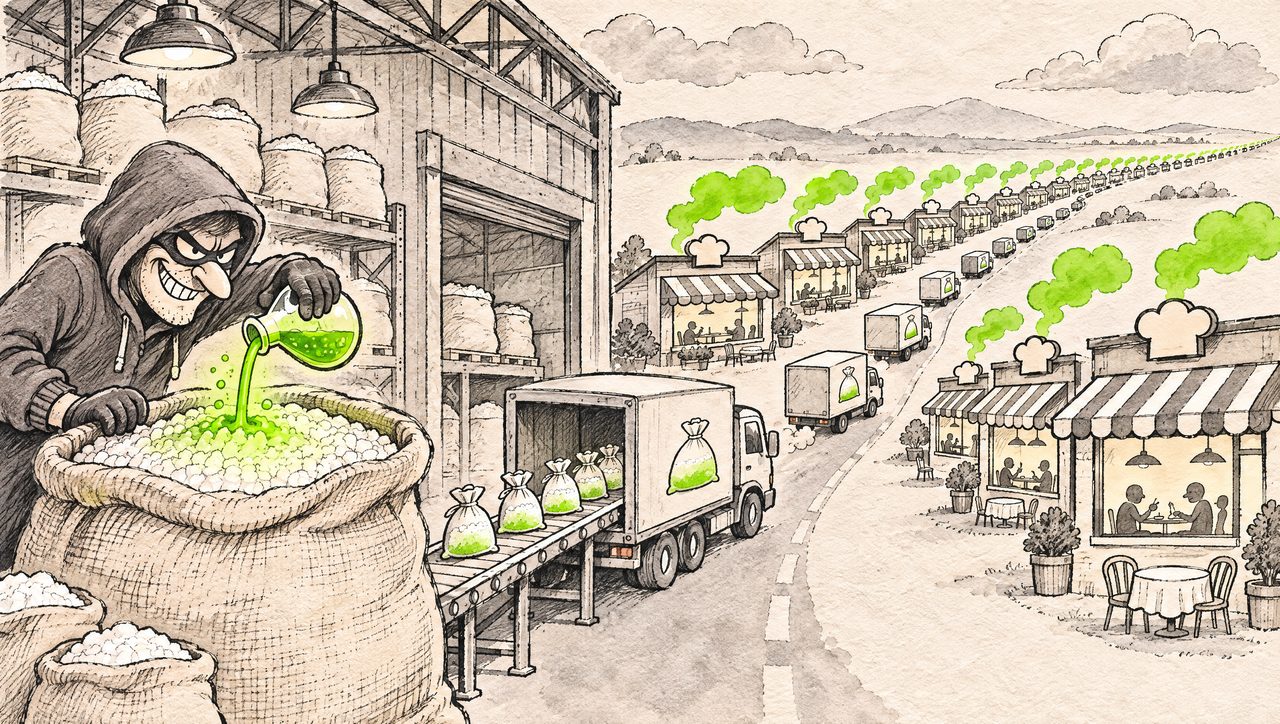
The same goes for cyberattacks. Imagine someone poisons a salt wholesaler that supplies 1,000 restaurants. The next day the poisoned salt reaches 1,000 restaurants and poisons 100,000 people. That is exactly what happened with Optimizely: the software it provided to hundreds of other sites was “infected” and caused problems for very well-known companies among its clients. That is why European law now requires organisations to check the security of their suppliers too, not just their own.
5. “We’ve been hit by ransomware. Do we pay or not?”
The organisation essentially has these roads:
- Recovery from backups. The best option, provided the backups weren’t encrypted too. Unfortunately, attackers today look for the backups first and destroy them. So today you need a cybersecurity specialist to advise you on how to detect an attack early and how not to find yourself without a backup at the critical moment.
- Starting from scratch. Painful and slow, but clean. We start with whatever we can find in the rubble. Sometimes this option leads to the collapse of the business, with unpredictable consequences later.
- Paying the ransom. It is the last resort and has legal limits, e.g. when the group is on sanctions lists.
- Working with cybersecurity professionals. In an incident like this, which you are experiencing for the first time, it is very important not to make irreversible choices. Ideally you have an advisor to help with the choices you make, the technical decisions, finding out whether the hacker is still inside your infrastructure and, of course, getting back to operating safely with as few days of downtime and as little cost as possible.
Paying the hackers does not guarantee that:
- the decryption tool the hacker gives us will fully work. It is often slow, or even destroys files.
- the stolen data will be deleted. Today almost every group steals before it encrypts, and the “promise to delete the data” given by an anonymous person is the best you’ve got,
- they won’t strike again, either the same hackers or others.
Very important: the risk of the breach remains even if the files are recovered. If we don’t establish (through digital forensics) how the hackers got into our infrastructure, which gaps they exploited and how they obtained the rights they had, or even more importantly what they left behind, e.g. accounts they control or backdoors, the threat is still open. That’s why recovery without a digital forensic investigation is half the job. There are of course several legal obligations after a cyberattack: notifying the Data Protection Authority and, for organisations that fall under NIS2 or DORA, an early warning within 24 hours. Always ask your appointed legal advisor or your organisation’s Data Protection Officer.
Obviously all of this can be discussed in advance with a cybersecurity professional, so that the impact of an attack is mitigated or eliminated.
6. “If the systems go down, what will we experience, and for how long?”
Citizens would see debit and credit cards that don’t go through, apps that don’t load, their bank not showing their balance or, worse, not letting them log in, queues, transport delays and great difficulty communicating. Cash suddenly becomes precious, just as we are being pushed to give it up.
The time it takes to restore systems depends mainly on what happens and how well prepared each organisation is:
- Hours: if there’s a technical failure or a bad update that can easily be undone, i.e. rolled back to the previous state.
- Days: a cyberattack on an organisation with very good, isolated and tested backups.
- Weeks: a cyberattack where several systems must be rebuilt from scratch, or when industrial systems are involved too.
- Permanent loss: if the backups were encrypted, weren’t kept off the network, or had never been tested. There is usually no way back from that.
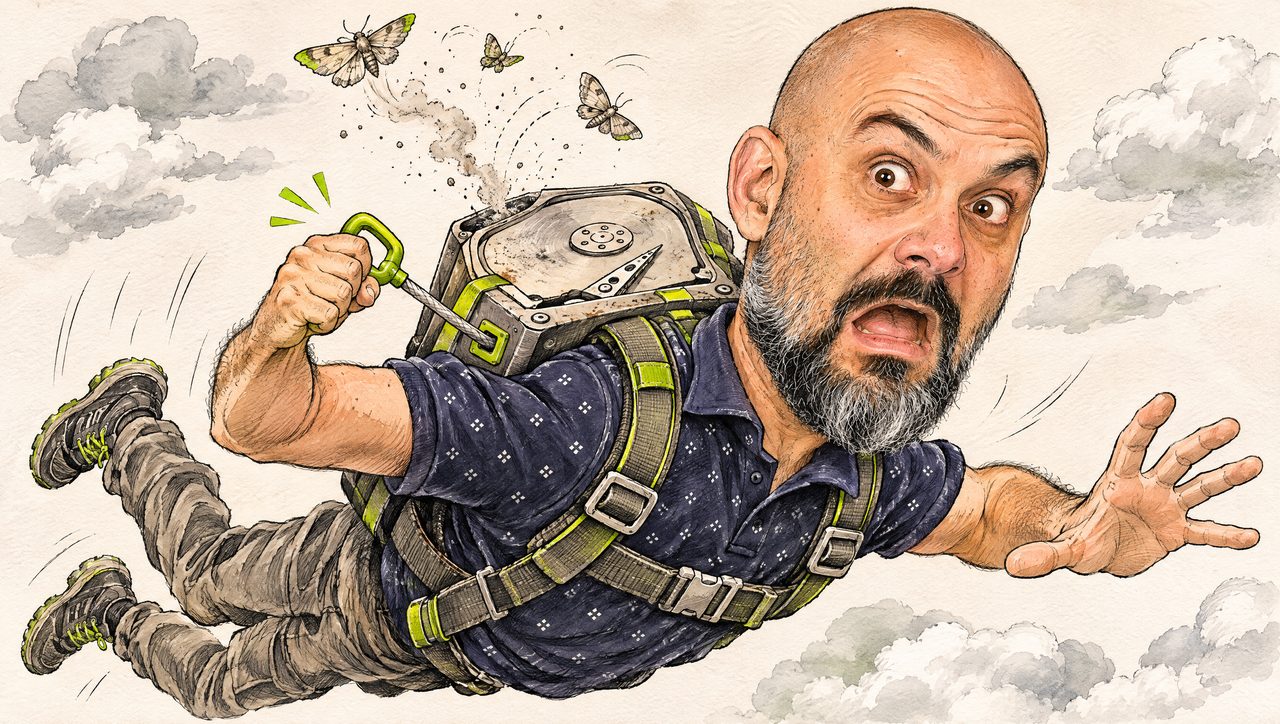
From our experience handling incidents, the critical question isn’t “do you have a backup?” but “when did you last restore it as a test?”. A backup that was never tested is like a parachute that never opened: you find out in mid-air… In our field we focus heavily on this and design systems with multiple ways to restore.
7. “Can hackers switch off the lights across a whole country?”
Technically it is possible. In practice it is extremely difficult. An attack on a power station has already happened: in Ukraine in 2016, exactly that took place. Malware cut the power supply to one fifth of Kyiv for about one hour. But we’re talking about one hour, in one city, under conditions of war.
For power, telecoms, banks and transport to go down at the same moment, the attackers would need:
- access to a great many different and independent organisations, while we know they don’t all run uniform systems,
- deep knowledge of attacking and operating industrial control systems, which doesn’t come from simply knowing IT,
- many months or perhaps several years of preparation without being noticed, sitting inside and watching those systems for changes and upgrades, each of which would change their plan,
- state resources plus a political decision and involvement by a strong state, since something like this amounts to an act of war.
I’d say the line between real risk and pure doom-mongering is this: the risk is real and shows up as partial, local outages and damage. A “generalised blackout” is, I believe, a movie scenario. What we all saw these days had other causes, which we analyse here.
8. “Is Greece ready for something like this?”
Institutionally, the country has taken important steps. There is a National Cybersecurity Authority, founded by Law 5086/2024, which supervises NIS2 obligations — a law passed to oblige critical organisations to take cybersecurity measures.
In December 2025 the new National Cybersecurity Strategy 2026–2030 was published, and the Authority’s audits began during 2026, with the help of the private sector. In addition, by 17 July 2026 the country had to officially designate its critical entities and record them in a national register.
The main weaknesses I see:
- A huge gap between paper and practice. Quite a few organisations have policies; few have tested them in an exercise.
- A shortage of specialised staff in cybersecurity, and of culture, especially in the public sector and the regions.
- Very old IT systems that are not easy to update.
- Smaller organisations and suppliers that lack the capital and are the weak link in the chain.
A meaningful business continuity plan must answer one simple question: “If tomorrow morning we are hit by a cyberattack and no computer works, what do we do to keep operating and get through the day without major problems?” It needs:
- plenty of manual procedures for critical functions, even on paper,
- a contact list and phone numbers, since we won’t have access to company email,
- backups off the network that cannot be altered,
- a clear order of priority for which systems we restore first,
- exercises. An emergency plan we have never tested won’t work at the moment of crisis.
9. “With artificial intelligence, can anyone become a hacker now?”
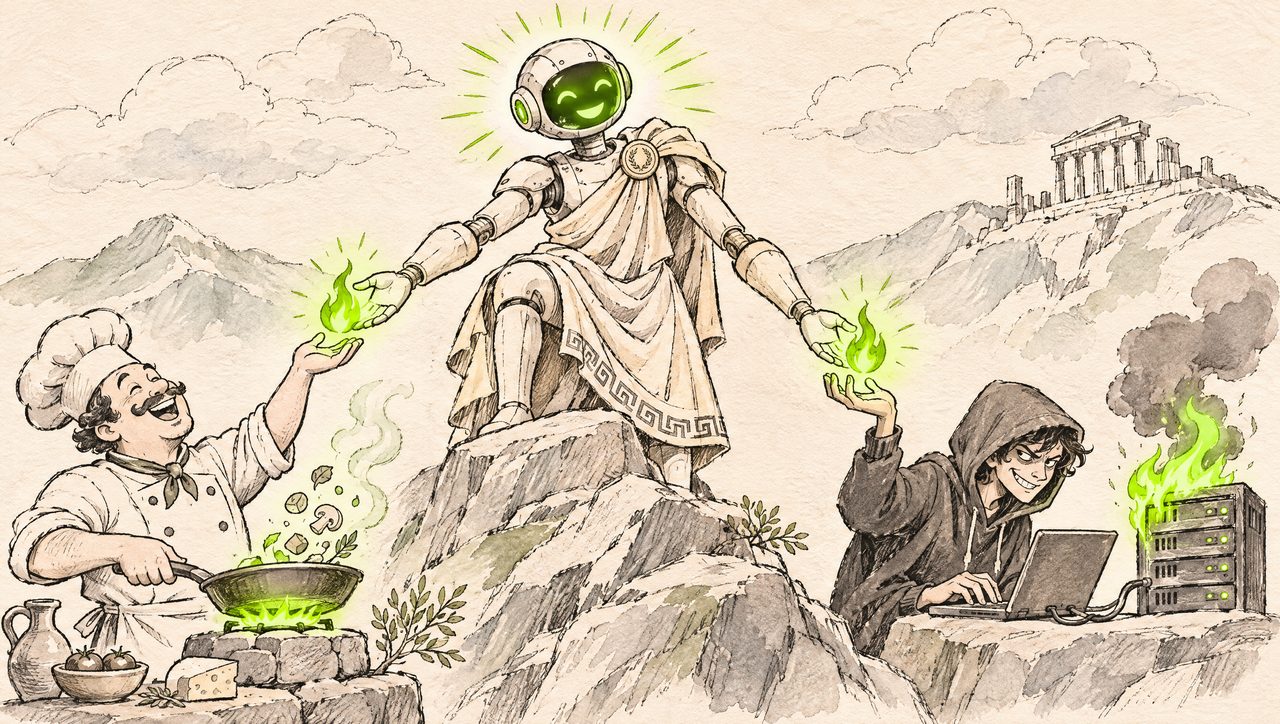
Artificial intelligence is like a modern Prometheus: it gave fire to everyone, both to those who use it to cook and to those who start fires…
In one month, one of the most advanced AI models, working with large organisations, found more than 6,000 high- or critical-severity vulnerabilities in software we all use! They were already there, they weren’t new; it simply found them much faster than humans.
In October, two critical security flaws in the PHP programming language, on which a very large part of the internet runs, were found with the help of AI. Security updates from the programs and operating systems we use every day have multiplied tenfold: in September, 998 vulnerabilities were fixed around Patch Tuesday, against 96 in the same period last year.
So we would answer yes; the conclusion is that the gap is shrinking, in both directions:
- Today an attacker with a small team, or a 15-year-old, can use AI to do what used to take 20 very experienced hackers. David got a “laser” sling.
- For the defender, for the first time even a small organisation can have tools that find its gaps before others do. The catch is that fixing them takes time and often manual work.
We are living through a transition. Within months we’re finding problems that existed for years; nobody had noticed them. At the same time we’re racing to patch them. In the rush we’ll see more outages, because when you renovate a house while living in it, at some point the power will be cut or there’ll be leaks. I believe that in 1–2 years we’ll reach a point where we are much safer than we were before. AI doesn’t pick a side. In practice, whoever uses it first and best wins. Of course, we know that every new technology is used first by the “bad guys”.
Maybe we’ll manage, in the end, to let the good side win before I retire…