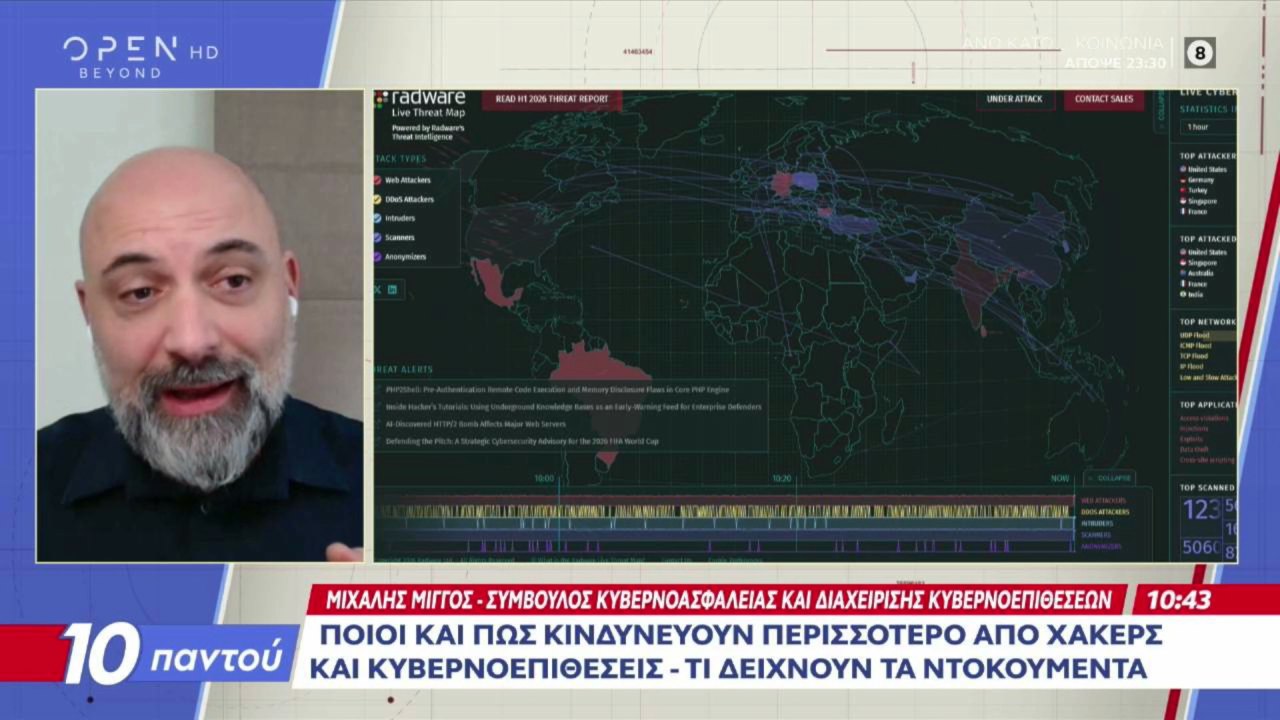
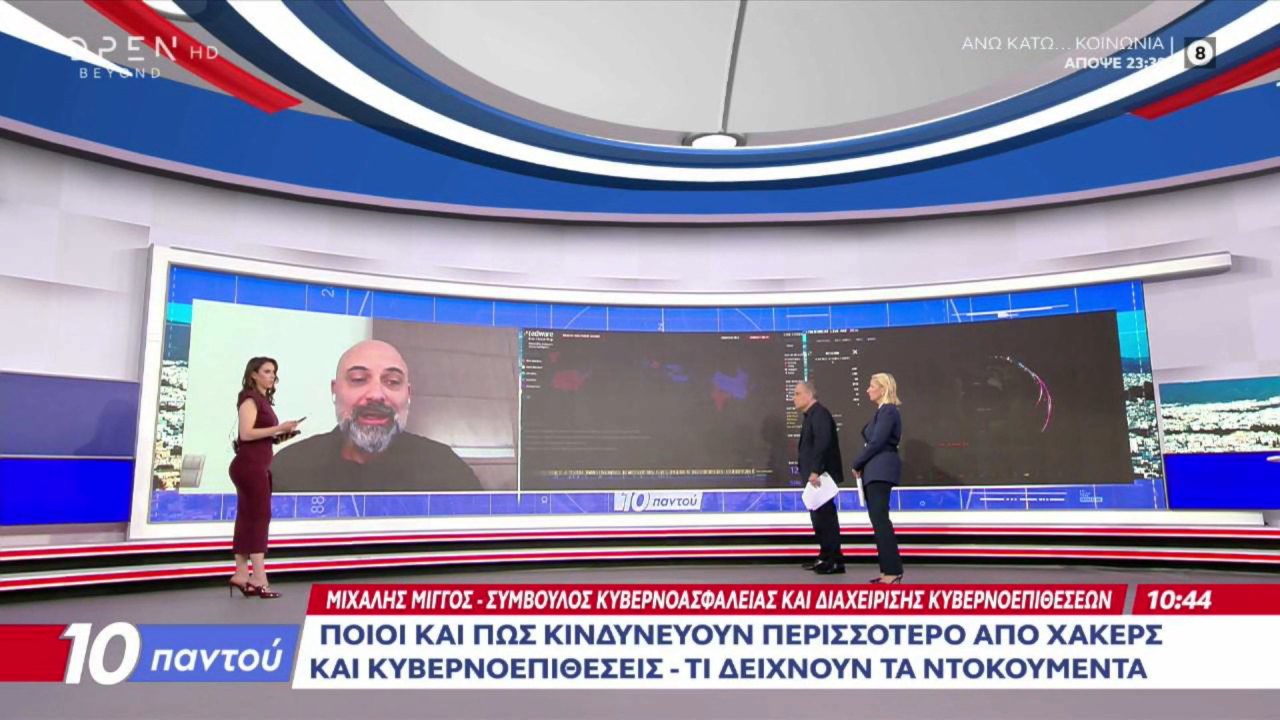
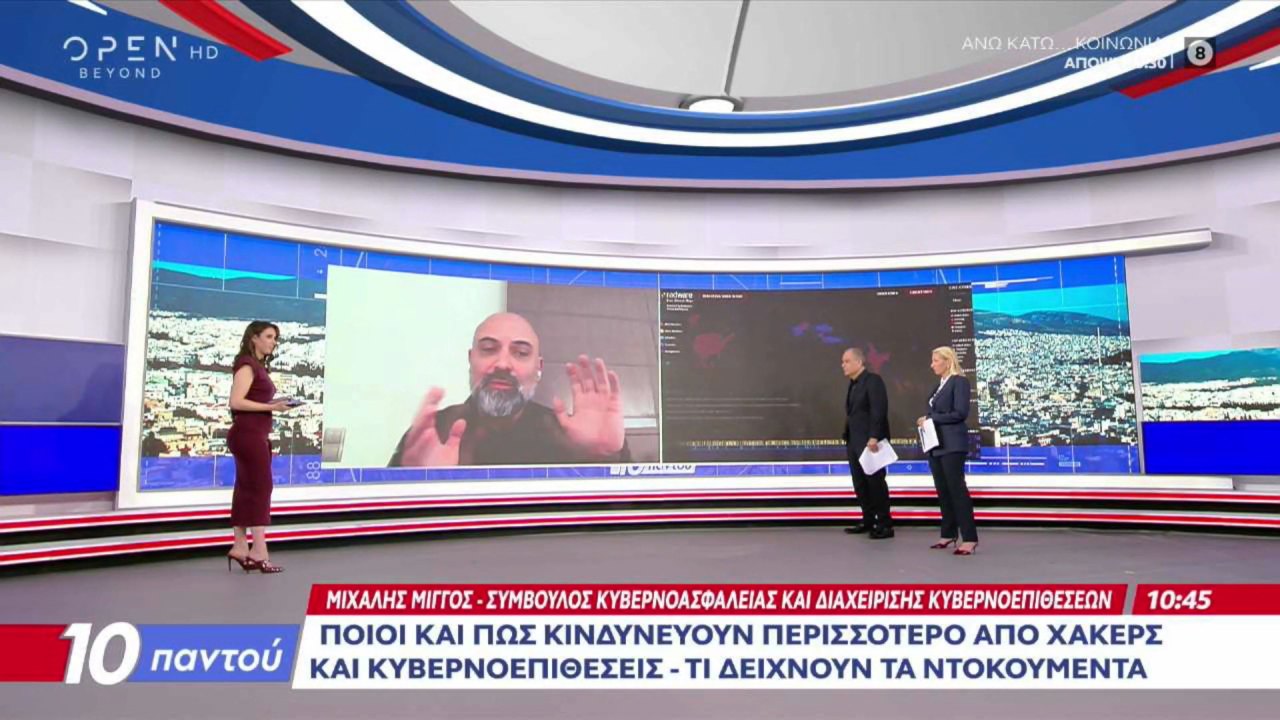
On 19 November 2026 I was back on «10 Pantou» on Greek channel OPEN, hosted by Nikos Stravelakis, to finish the conversation we had started the day before. The question of the show was the one I keep hearing everywhere: are all these outages, from flights and Microsoft to Apple, cyberattacks or just coincidences?
The video (in Greek) starts at the right point of the discussion:
A week when everything kept breaking
If it felt like nothing worked lately, you weren’t imagining it:
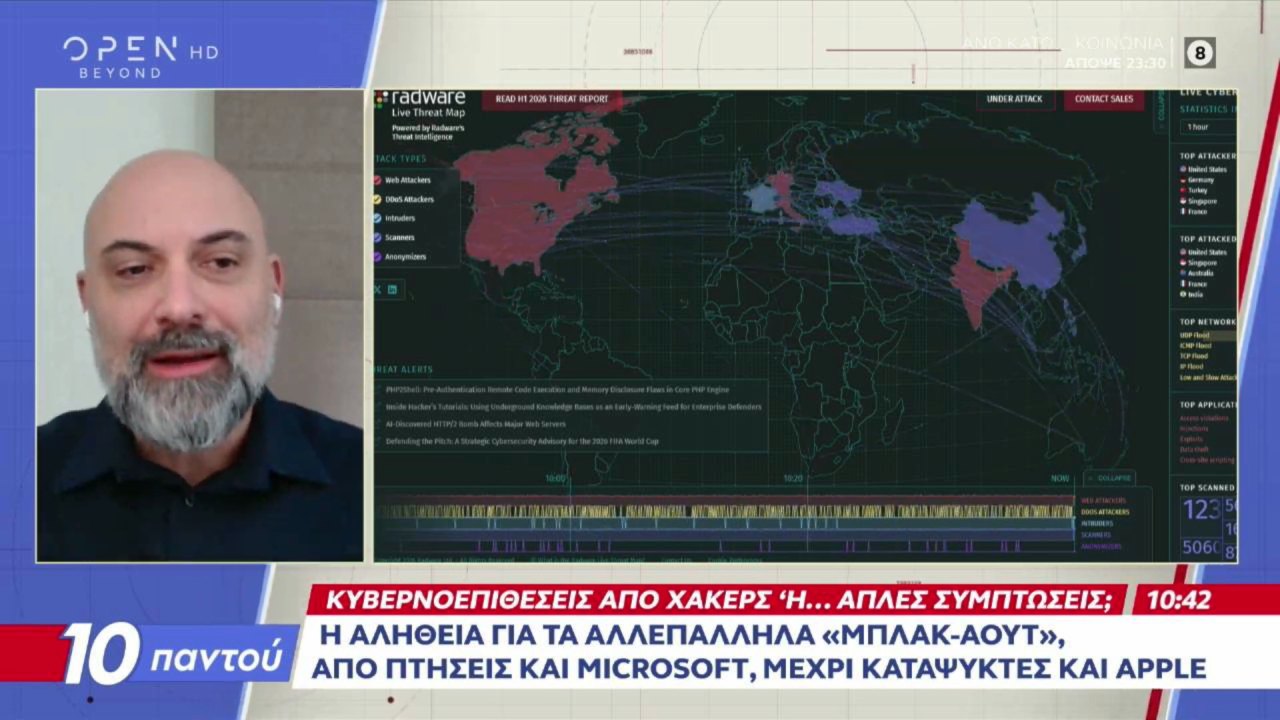
- 12–13 November: a global Microsoft 365 outage (Outlook, Teams, Copilot), with reports from dozens of countries within an hour. Airports and airlines were hit, including in Greece.
- Days later: the US FAA ordered a nationwide ground stop after a problem in its telecommunications network.
- 16 November: disruptions at United Airlines and several major US banks.
- 17 November: outages at the App Store, Apple Music and AppleCare, which Apple attributed to an internal update.
In most cases the companies said the same thing: a technical issue, not a cyberattack.
So: coincidence or attack?
My answer on air: a run of coincidences, I would say. Of all these incidents, maybe half are cyberattacks, possibly fewer.
The rest have a different explanation, and an equally worrying one: companies are racing to patch their systems, because they know the vulnerabilities are there. They make many changes at once, fast, and some of those changes break things. A rushed update can take a service down as effectively as a hacker.
And the reason they’re racing comes down to one thing: AI.
What changed in April
Something we didn’t get to say the day before: since April 2026, technology and cybersecurity companies have had access to a very powerful AI tool that finds security flaws at a pace we have never seen. Where a team used to find 10 flaws a month, it now finds 100.
The key point: these flaws aren’t new. They have been there for 10 or 20 years. We are simply finding them faster, and finding more of them. That’s why we’re seeing a wave of updates, fixes and, inevitably, failures.
The same goes for the other side: it’s as if we handed both the hackers and the defenders a super-weapon. Like nuclear energy, it can be used for good or for harm. And nothing guarantees that such a tool, or a similar one, won’t end up in the wrong hands.
From one person to a thousand attacks at once
Nikos Stravelakis asked a sharp question: are these attacks carried out by people or by computers?
This is the big shift of recent years:
- Once, a cyberattack needed one person.
- Then came scripting, and one person could run ten at once.
- Now AI is here, and it can run a thousand at once, independently of any human.
So we have more attacks, more automated, while at the same time we’re discovering more vulnerabilities.
What those maps with the flashing lights actually show
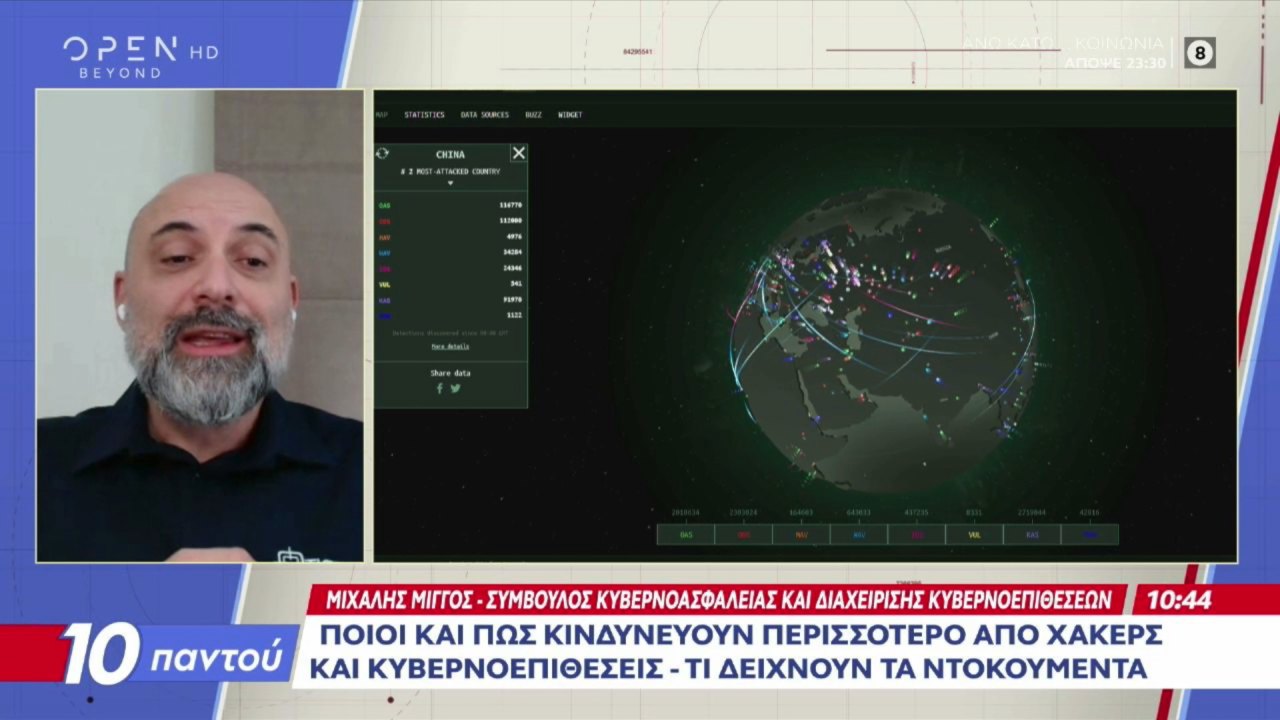
On the show we displayed live cyberattack maps, with lines running from one country to another. Impressive, but they need two clarifications:
- Every line is an attempt, not a success. It’s someone knocking on a door right now. Every second there are not thousands but millions of such attempts worldwide.
- The country you see isn’t necessarily the real one. An attack may appear to come from the US while the attacker is sitting next door. The address is a mask.
And, to be clear, this was happening ten years ago too. It’s not new. What’s new is the speed and the volume.
Two moves you can make today
At the end, Stravelakis asked for two tips for viewers. Here they are, as I gave them:
1. Install updates the same day. Whenever an update appears on your phone or computer, install it that same day. Every update means someone found a flaw. Once it’s public, it’s a race: us to close it, or them to exploit it. With AI, that window is shrinking dramatically.
2. Never reuse the same password. If you use the same password for your bank, your phone and the online shop you buy from, one leak opens everything. A big mistake.
On air I only had time for those two. Here I’ll add two more that go hand in hand with them:
- Use a password manager, so you have a unique, strong password everywhere without having to remember them.
- Turn on multi-factor authentication (MFA) for email, banking and social media. Even if a password leaks, it’s not enough on its own.
The takeaway
Not every outage is the work of hackers. But it’s no accident they’re happening now. We’re living through a period in which AI has sped everyone up: attackers, defenders, and the teams rushing to patch decades-old systems.
We can’t control Microsoft or Apple. But we can install today’s update and change the password we use everywhere. Those two steps remove most of the risk for everyday users.
We saw this before in 2024, with the global Microsoft outage caused by a faulty CrowdStrike update (in Greek): a bad update, not hackers.
See also my previous appearance on the same show, about hackers in supermarket freezers and “smart” devices, and my talk at Acronis Day Athens 2026 on how small mistakes become major incidents.
Sources: AP: Apple joins a parade of technology hiccups · Protothema: Global Microsoft outage across 74 countries · TO VIMA: Microsoft outage at Athens airport · FOX: Outages everywhere – what’s behind them · Constellation Research: Project Glasswing (April 2026)
Enjoyed this? Send it to someone who always postpones updates “for later”. Your comments are always welcome!